
The lungs are an excellent example of a natural fractal organ. If you look at the tree upside-down (mouse over the image), you can see that the lungs share the same branching pattern as the trees. And it is for good reason! Both the trees and lungs have evolved to serve a similar function – respiration. Since they perform a similar function, it should not be surprising that they share a similar structure. This common concept in science is known as the Structure-Function Relationship. Many of the fractals in biological systems we will explore have evolved their structures in order to perform extraordinary functions. In the case of Lungs and Trees, they both breathe. In animals, the lungs breathe in oxygen and breathe out CO2. In plants, the process happens in reverse. Thus animals and plants are two halves of the same respiratory cycle. But here’s the key to their shared structure: They both need a large surface area to function well. The amount of gas (O2and CO2) that can be exchanged through the leaves on a tree or the lungs in an animal is directly proportional to their total surface area. Although the volume of a pair of human lungs is only ~4 – 6 litres, the surface area of the same pair of lungs is between 50 and 100 square meters. That’s about the same area as a tennis court!

Another naturally occurring fractal pattern is a lightning bolt. As Benoit Mandelbrot noted in the opening quotation, lightning does not travel in straight lines. Rather, it follows a chaotic, jagged path, formed as the huge charge separation built up in the sky suddenly breaks down. The majority of a lightning bolt is generally hidden in a cloud, much as an iceberg hides beneath the ocean. Lightning can be very large, spanning several kilometers, but it is formed in microseconds. Thunder is a fractal sound. It is caused by the superheating of air. Because the pathway of the lightning bolt is a jagged fractal in 3D space, the time it takes to reach your ear varies, and the thunder rumbles in a corresponding fractal pattern.

Credits: Leonardo Borja.
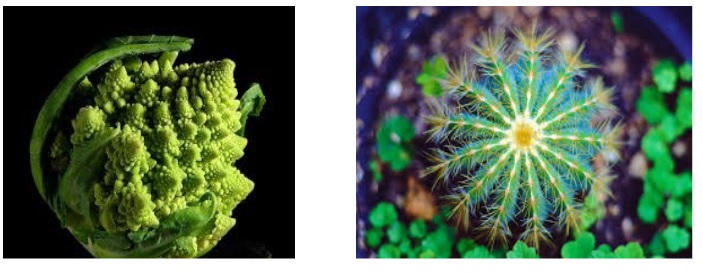
Plants:The structure of so much organic life follows self-similar, fractal patterns, which can be observed in flowers, trees, plants, and even mountains and coastlines.

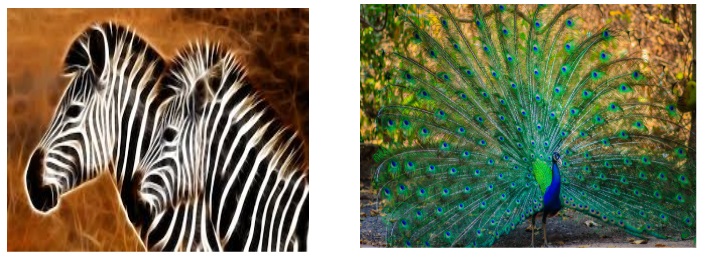
Animals:

Credits: Franklin Cerin
Where can we find fractals?
- Plants:
- Animals:
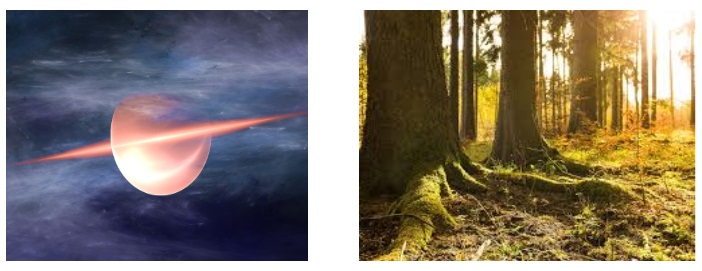
- Atmospheric:
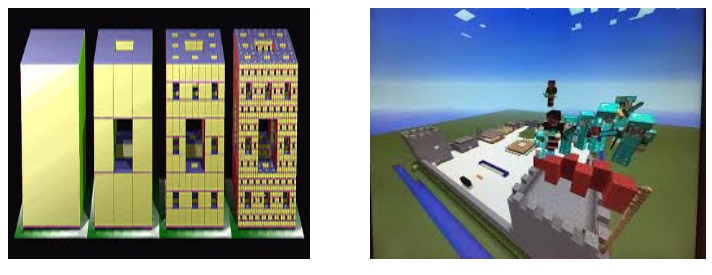
- Technology:
 Fractal Invasion